
 Eligibility for Australian citizenship by conferral can arise in a variety of ways.
The most common is to satisfy the ‘general eligibility criteria’ and have successfully completed a citizenship test. In short, this is the common pathway for migrants who have lived in Australia on visas and ultimately obtained permanent residency. Once they have been present in Australia for the required period, they could meet requirements for citizenship by conferral under the general eligibility criteria.
However, if an individual is not eligible under the general criteria, citizenship by conferral also caters for some more unique circumstances:
- Persons who were born to a former Australian citizen;
- Persons born in ‘the Territory of Papua’ before 16 September 1975;
- Stateless persons.
The article below describes the first of these.
The Australian Citizenship Act (1948)
For some context, citizenship was previously administered by the Australian Citizenship Act (1948) (1948 Act).
Eventually, the 1948 Act no longer reflected modern Australia:
- It was greatly tied to British nationality concepts;
- It had strict provisions related to the automatic loss of Australian citizenship in certain circumstances (this will become relevant below);
- It didn’t reflect multicultural Australia.
Consequently, the 1948 Act was repealed and replaced by the current Citizenship Act which commenced on 1 July 2007 (2007 Act).
The current Act also notably updated the laws on citizenship by conferral and citizenship by descent.
Persons born outside Australia to a former Australian citizen
More commonly, if a person is born outside to a current Australian parent, they would rationally be eligible for Australian citizenship by descent. The overarching requirement is that the child had an Australian parent at time of birth.
However, there may still exist a small cohort of people who, at time of birth, did not have an Australian parent because that parent lost their citizenship prior. Consequently citizenship by descent would not be possible.
Despite this, subsection 21(6) of the current 2007 Act makes citizenship by conferral possible for a person born outside Australia whose parent was an Australian but ceased to be an Australian due to section 17 of the old 1948 Act.
The elements of subsection 21(6) of the 2007 Act are as follows:
1. Place of birth
The applicant must have been born outside Australia, as defined by section 3. Section 3 provides that Australia, when used in a geographical sense, includes external territories (Norfolk Island, Christmas Island or the Cocos (Keeling) Islands).
2. Be of good character
If the applicant is aged 18 or over, they must be of good character at time of decision.
3. Status of parent at time of applicant’s birth
This is the most important part. Paragraph 21(6)(b) and (c) requires that:
- the relevant parent of the applicant must not have been an Australian at the time of the applicant’s birth, and
- that, prior to the applicant’s birth, the parent ceased to be an Australian citizen under section 17 of the 1948 Act.
It is worth noting that the parent, who ceased to be an Australian under section 17 of the 1948 Act, is not required to have re-acquired Australian citizenship in order for the applicant to meet subsection 21(6) of the 2007 Act.
What was section 17 of the 1948 Act?
Section 17 was in essence the automatic loss of Australian citizenship if a person outside Australia of “full age” and “full capacity” acquired the citizenship of another country:
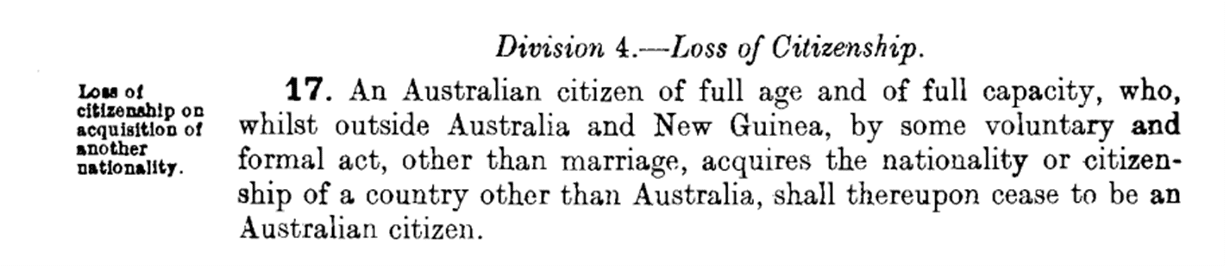
To clarify section 17 further:
- From 26 January 1949 to 30 November 1973, a person was considered to be of full age if they were aged 21 or over;
- From 1 December 1973, a person was of full age if they were aged 18 or over;
- A person of full capacity able to make informed decisions and understands the consequences of their actions.
Section 17 is requires that the person had to have undertaken a voluntary and formal act to acquire the citizenship of another country. This would usually mean that they themselves made an application to become a citizen, or applied to re-acquire a citizenship that they had previously lost. In other words, the acquisition of their non-Australian citizenship had to be a deliberate and conscious decision.
Some scenarios from Department policy that attempts to clarify this include:
- an Australian who acquires Irish citizenship because their father was born there is not necessarily affected by section 17, because they are merely applying for evidence of a citizenship that they were entitled to from birth.
- On the other hand, if the person were to register as an Irish citizen because their grandfather was born there, then that person would have ceased to be an Australian citizen under section 17 because they voluntarily applied to become a new Irish citizen.
Section 17 was repealed from the 1948 Act on 4 April 2002.
The practical challenges
A major difficulty with these matters would be that the Department of Home Affairs (and its predecessors) do not have complete records of people who lost their Australian citizenship under this provision. This is because citizenship cessation under section 17 was “by operation of law” or automatic when a particular event occurs, rather than a process that would be manually assessed and actioned.
Furthermore, there was no requirement for a person to report their acquisition of another country’s citizenship, and so the number of people who were affected by section 17 may be greater than what is known. Consequently, when it comes to their children born overseas, confirming that the parent lost their Australian citizenship, and more specifically lost it due to section 17 could be very difficult to prove and confirm without family or historical records.
For those exploring the former citizenship of their parents, the National Archives of Australia may be an interesting place to start.
How can Hannan Tew Lawyers help?
At Hannan Tew, our team of dedicated lawyers have significant experience across complex citizenship matters. If you require immigration assistance or have any other migration-related queries, please get in touch with our experienced team by email at [email protected] or by phone on +61 3 9016 0484.
You can also subscribe to our Australian immigration newsletter to stay up to date with the latest immigration news.